Pages

Showing posts with label Books. Show all posts

Tuesday, April 13, 2021

Book Review: To the Kwai - and Back by Ronald Searle


I have deep respect for war artists. Such a contemporary is Richard Johnson who has accompanied American troops to the frontline in the Middle East to document scenes of military and combat with little more than paper, pen, and pencil. He stands in a great centuries-old tradition of artists who used their talents to record scenes and experiences under fire and in the most harrowing times. Hence when I came across this book in the library, I borrowed it without hesitation. It is one thing to be engaged to be a combat artist. It is quite another to have documented the experience as a POW in captivity, risking one’s very life just to draw. Searle does just that. And to bring things closer to home, his experience is the experience of my country - Singapore - of just a generation or two ago. Searle was a POW during Singapore’s Japanese Occupation during the Second World War.


Searle was just 19 when he joined the army. A month after he was sent to Singapore, he was captured and spent the next 3 years as a POW. He was interned in Singapore before being sent to work on the infamous Death Railway in Burma. He survived the ordeal and was sent back to Singapore to be held captive at Changi Gaol.


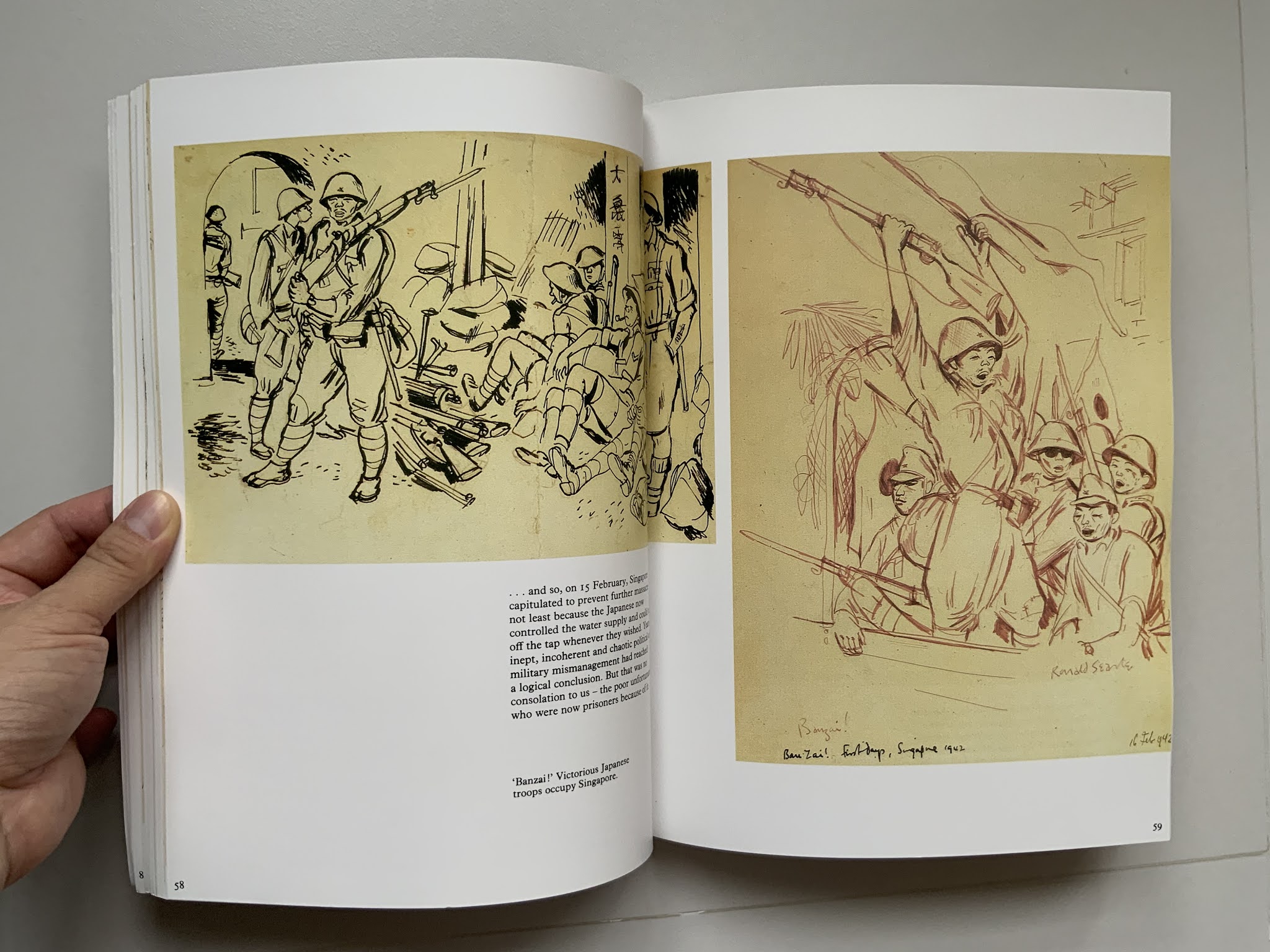


Searle records his experiences as-is, sparing neither the incompetence, brutality nor the humanity of allies and captors alike. He uses a variety of styles from caricature to quick rough sketches to more finely rendered pieces as time and energy allowed. His narrative is personal (do read the text in the photos I’ve uploaded) and even the gaps in his narrative and sketches tell a story - he was unable to do many sketches because of the circumstances.


Vignettes of brutality are interspersed with others of tranquility and humanity, such as a moment when Searle had the opportunity to sketch undisturbed, or when he was picked out by the prison commandant for some personal work, and a conversation revealed that the commander was also an artist. The latter gave Searle some coloured pencils and wax crayons, which he used for some sketches. Another Japanese soldier requested a portrait. Searle shows their humanity through these encounters - these were men forced into circumstances like he was, and some of them would not have been doing what they were had they the choice, in fact, Searle reserves some of his more scathing remarks for the incompetence of the Allied Forces.


The surrender of the Japanese in 1945 did not immediately result in the release of POWs. The generals in Vietnam and Singapore were bent to continue figting and rumours floated about that all captives would be killed. Thankfully for Searle (and for us), both he and his sketches survived.


We owe a debt to courageous men like Searle who risked their lives to give us visuals of such a dark time in our global and national history. It took tremendous courage to create and hide these incriminating sketches from his captors, and publish them years after the ordeal. As an endorsement on the back cover reads, “This book should never be out of print”. Let no one say that artists are non- essential. We are all the richer for the brave strokes of these men.


Sunday, March 28, 2021

The Faith, the Dream by KC Lee

 We are all time-travellers journeying through life. My friend KC Lee has recently taken it upon himself to chronicle that journey. Given away while he was an infant, he traces the contours of his life and his struggles through his adventures as an artist and businessman, and through marriage and fatherhood in a 17.5 metre-long sketch-autobiography (the original being 88m long and featured in the Malaysia Book of Records). He tells of his long search for his biological family, and how by a strange twist of fate, his biological father was - unknown to them both - at one point a colleague of his.

Here are some photos of the book. Mind you it’s no small paperback, and it’s one continuous page so I can’t stretch it out in its entirety. It would be longer than the length of my flat!

Book with sleeve


Inside pages are “accordian-style” with one 17m page


Back cover

I enjoy biographies. This is probably the first sketch autobiography I’ve ever seen, and certainly the only one in my library. You can tell lots of love and effort went into this.

If anyone is interested in getting a copy, you can contact KC at https://www.facebook.com/profile.php?id=100008348147555 . The book is on sale for 120 RM.

My friend Parka has also done a review at his famous blog and a video review too:


Friday, January 3, 2014

A Glimpse of Ancient Angkor - Required Reading

In the last 2 months, I've had at least 4 (groups of) friends who visited Siem Reap. But it won't be long till I get to see the magnificence of Angkor with my own eyes. There are many books on the ancient city, and I have borrowed not a few travel guides from the library over the months. The most significant book, however, is one I borrowed from one of my to-be travel mates, who at one point taught Cambodian art history in a local school as part of his curriculum. This book is none other than Zhou Daguan's A Record of Cambodia: The Land and its People.


What makes this volume so special? It is the only surviving eyewitness account of Angkor while it was still an inhabited and thriving city. Written by a Chinese emissary on a diplomatic mission to Angkor in the 13th century, the account describes life as it was back at the height of the kingdom's glory. While the record is only a short 8000 characters long and possibly fragmented in its preservation, and while it may be biased with an educated Chinese foreigner's perspective, it nevertheless gives a rare glimpse into the lives of the Angkorians as it used to be and the splendour of the buildings before the city was mysteriously abandoned to the jungle. For an artist intending to sketch the ruins of the ancient Khmer empire, the descriptions in the book give me the material to imagine what they might have once looked like - towers, bridges and statues of gold; tiles of clay and lead; a statue of reclining Buddha with water flowing from its navel; private pools at every house or every few houses. What is now a barren structure swarming with tourists was once a living, breathing city with people, markets, kings and noblemen, slaves and merchants - one of (if not) the greatest kingdoms in Southeast Asia.

Yet even the greatest kingdoms may be laid low. From Zhou's account, we see not only the spendour, but the less flattering aspects of Khmer life. Some customs are unimaginable to us, such as the ritual of "zhentan". Another account describes how ill-equipped and disorganized the army was (they wore no armour, had no projectiles, and no strategy). One can speculate about what caused the Khmers to abandon their great city to the jungle and move southeast, eventually making their capital in Phnom Penh, but until more light is shed, we cannot be entirely sure. Most likely the abandonment of Angkor was due to a combination of factors, not the least of which was Siamese aggression. Ironical, though, since Angkor is just north of Siem Reap (Khmer for "Siam's Defeat").

The documentary below gives a good starting point for a look into Angkor in its heyday, but if you are a history buff planning for a trip to Angkor, I would highly recommend getting Zhou Daguan's book translated by Peter Harris. This recent English translation was not translated from the earlier French translations, but directly from the original Chinese text. It is full of helpful notes and very readable, and will certainly make your visit richer.


Saturday, August 3, 2013

China Tour Guide: Cartoons by Wang Qicheng

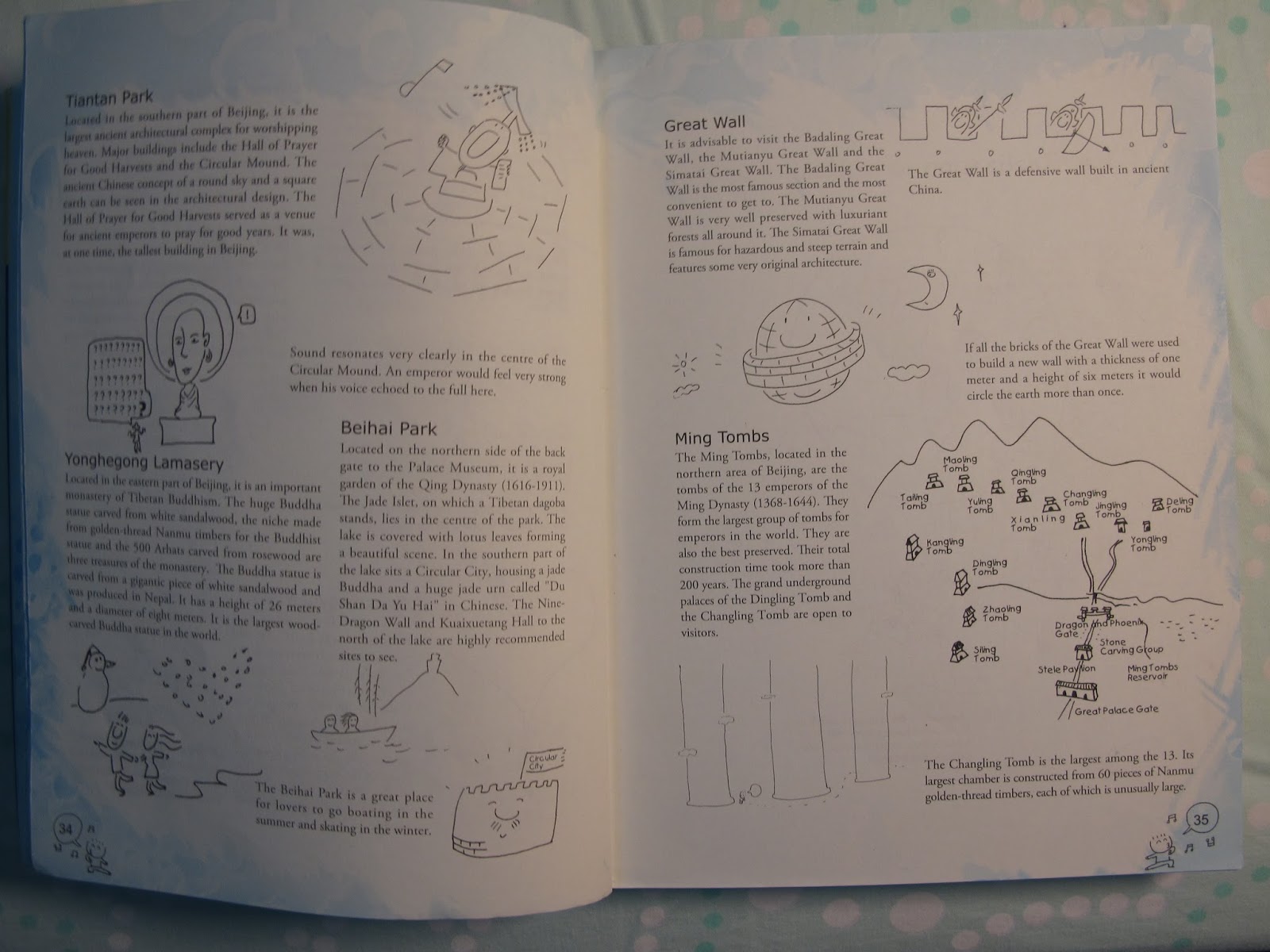
I picked up this book from the library today as I went to return (and re-borrow) some travel books. I saw it sitting in the art section shelf and got curious. It's a book of cartoons on the whole of China by a Chinese cartoonist named Wang Qicheng.


Inside you will find cute little cartoons on different parts of China, things to see and experience, and short writeups. Methinks that some sketchpackers would be happy to learn from and even use this approach!


The drawings are very simple (though not ineffective) lineart. I'm guessing the style was adopted because of the sheer volume of illustrations (the book is a whopping 330 pages thick!). If you think you're not much of a sketcher, and are too afraid to try out urban sketching, why not record your experiences in simple cartoons? Urban Sketcher Chris Buchholz wrote, "A sketchbook is also the ultimate souvenir."

If you're looking for a comprehensive travel book with travel information, this book isn't for you. But it may be just the right book for your young one! Lots of cute pictures and not very text-heavy.

Wang Qicheng has other books on Beijing and Shanghai, too.