Pages

Monday, September 30, 2019

Sketching Melaka

I have a certain fondness for Melaka (Malacca). Its history is closely tied to Singapore’s history. It is said that the last king of Singapura (Singapore’s old name), Parameswara (Sultan Iskandar Shah, but historical records vary) fled an Majapahit invasion and founded the new city. Like Singapura (meaning “lion city” being named after it was founded by a Palembang prince who reportedly saw a lion after surviving a storm en-route by casting his crown into the sea), Melaka got its name from the Melaka tree Parameswara was resting under when he saw how a brave mousedeer kicked his hunting dog into the water. He took it as a good omen (probably after having to flee a powerful enemy) and the rest is history. That was in 1402. Over the years, it grew into a regional power establishing alliances with China during the Ming Dynasty

Over the centuries, Melaka’s spice position along the spice trade route became the desire of European powers. The Portuguese were the first to conquer the city in 1511, followed by the Dutch in 1641, who later ceded the city to the British in 1824 in exchange for Bencoolen on Sumatra. In 1948, Melaka became part of the Federation of Malaya (today Malaysia) which gained independence from British rule in 1957 after World War II.

Vestiges of colonial and pre-colonial Melaka can still be seen, including the tombs of its early heroes. Historical records and verification can be rather sketchy at parts, but interesting nonetheless. In recent years, a book was published documenting pre-1402 Melaka. The findings are controversial to some, but others think the writer builds a strong case.

I visited Melaka as part of my school history trip in 1993. I have fond memories of that trip. It was probably the first time i got to design a T-shirt for a school activity, and I drew the Porta de Santiago gate below. I don’t remember where I got the reference photo from, since those were pre-Google days. I wish I still had that shirt.

There are currently 3 sketches in his post which I did over 2 trips. They were done in simple linework using Platinum Preppy fountain pens. I will update with more should I get the chance to visit again. There are other places I would like to draw such as Kampong Morten, Bukit Cina, Jonker Walk, and other historical sites and places of interest.


Porta de Santiago
Copyright © Favian Ee


This gateway is almost all that remains of the once impregnable Portuguese fortress, the A’Famosa, whose walls once circled the city. Behind the fort is St Paul’s Hill, on top of which is the remains of St Paul’s Church which I sketched in the third sketch below. This is a popular tourist spot, but less crowded on weekdays. There’s a mall opposite if you need respite from the heat. I took cover under a tree while sketching this and a bird bombed my sketch pouch. Fortunately the drawing was unscathed.

Dutch Square
Copyright © Favian Ee


Red is the colour of the Dutch Square. On the left is the clocktower. Christ Church (an Anglican church) is in the middle, and the Stadthuys (an old Dutch word for "Town Hall") is to the right, said to be the oldest and largest surviving Dutch colonial building in the East. Once the official residence of Dutch governors and officials, it now houses the Museum of History and Ethography. Services are still held in the church, which are open to public. This square sits at the gateway to the famous Jonker Walk, which has become a very touristy shopping street. Jonker Walk comes alive from Friday nights all through Sunday as street stalls ply their wares and feed visitors. Garish trishaws decorated with cartoon characters and plush toys while blasting loud music (if you can call that music) crowd around the Dutch Square where they pick up and drop off passengers.

St Paul's Church
Copyright © Favian Ee


On a hill behind the Porta de Santiago is the roofless St Paul's Church. I drew this piece on a different trip. To the right is a white statue of the Jesuit missionary St Francis Xavier. You may notice he is missing his right hand. Legend has it that it was sculpted with the hand, but the sculptor didn't realise that the saint's hand was removed for him to be canonized. "Miraculously", during a thunderstorm, a tree fell and lopped the hand right off the statue. That was the story I was told by our tour guide when I visited in 1993. It was one of several stories of the miracles of St Francis Xavier. Inside the church, you will find a burial vault and several large tombstones.


Previous post on my Melaka sketch trip: https://sketchpacker.blogspot.com/2018/04/melaka-anniversary-trip.html

Thursday, August 22, 2019

Drawing Home

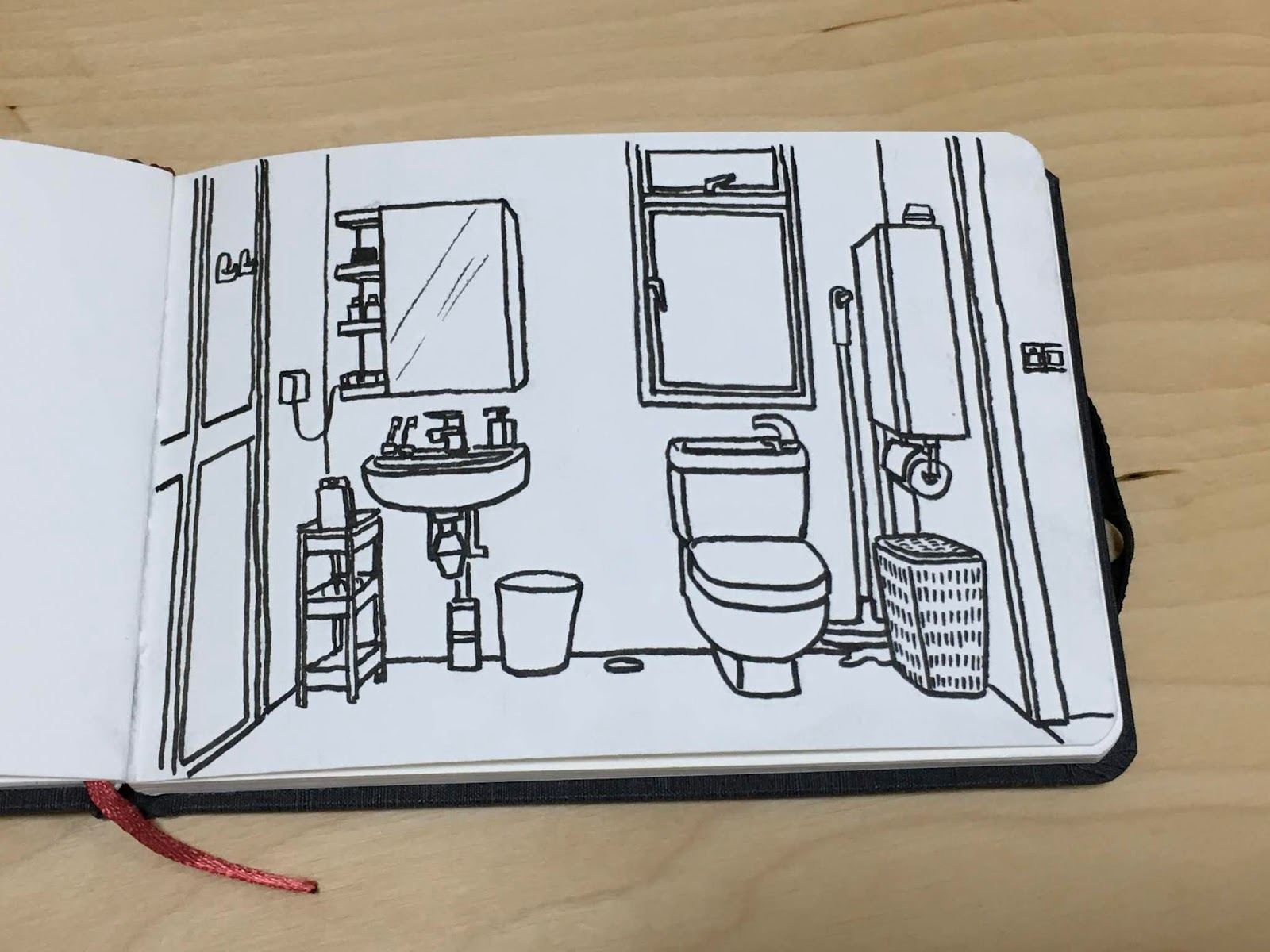
It’s almost a year since I collected the keys to my first and very own flat. It’s a small 2-room flat with a floor area of 45 sqm. Renovating this space would be the most expensive and largest project I had ever undertaken. Needless to say, a lot of planning was necessary, and being able to draw was a huge plus. My concept sketches were not exactly to scale, but roughly based on the measurements I took at the showflat (which was larger than the actual flat, I think), but the idea was there and I could use them to show my ID what I wanted. You can take a look and see what compromises I had to make due to space constraints in the end.

Living Room


Bedroom


Kitchen


Bathroom


Maybe I'll do another round of sketches of my flat now that it's completed, but being able to draw was really helpful. You don't need to draw well to communicate your ideas. A few fundamental skills (eg. proportion, perspective, texture, tone, colour) will get you a long way and these are things that can be learned.

Thursday, July 25, 2019

Missing Singapore

Singapore is rapidly developing. One of the highlights of being an Urban Sketcher is to capture disappearing places. As the old gets replaced by the new, more and more spaces go missing. These spaces are holders of memories. We ate and drank here. We loved and broke up there. We brought our children and parents there. We lived and died here. When those spaces are removed, we feel displaced. Call it "nostalgia" if you like. I call it "home".

I've tried to capture some of these places in my sketches, particularly in my Perfect Sketchbook B5. Why that particular sketchbook? Cos I spent so much on it, and even went and bought the frame specially designed to hold the sketchbook for another tidy sum. The sketches had to be meaningful, worthy for such an investment.

I'd like to share some of those sketches here. Over time I might add some more.

Enjoy.


Pearl Bank Apartments

The unusual horseshoe-shaped tower of Pearl Bank Apartments used to stand atop Pearl’s Hill, overlooking Chinatown and Outram Park. Inspired by Brutalist architecture, it was designed by Singaporean architect Tan Cheng Siong and completed in 1976. It was the first all-housing project to be undertaken in the Urban Renewal Department of the Housing and Development Board’s Sale of Sites programme, and the first residential development in Singapore to employ the slip-form construction technique. At 113m, it was the tallest residential building in Singapore when it was built. It was first put up for en bloc sale in 2007 and was sold only in 2018 after 2 failed bids. Demolitions for redevelopment of this icon started in 2019.

 Image Copyright © Favian Ee  Mar 2018


Sembawang Hot Spring

Located at Gambas Avenue at the edge of Sembawang and Yishun, Sembawang Hot Spring is the only natural hot spring on mainland Singapore. It was discovered in 1909 by Seah Eng Keong in his pineapple estate. Fraser & Neave (F&N) acquired the site in 1922 and sold bottled water from the spring under the brand Seletaris. Many locals came to the spring to enjoy the hot water and soothe their aches and pains. The spring was closed in 2018 as the area underwent redevelopment into Sembawang Hot Spring Park, which is scheduled to open in late 2019.

 Image Copyright © Favian Ee  Mar 2018


Kampong Java Park

Just behind KK Women’s and Children’s Hospital (formerly Kandang Kerbau Hospital) stood Kampong Java Park, a haven of peace and tranquility where patients could enjoy a pocket of nature in the city as they underwent their treatments. Formerly a Christian cemetary, the area was developed into a park which opened in 1973. It was the first park to have ornamental lighting, made of steel poles and plastic light covers along its footpath. The park was closed in 2018 to make way for an expressway tunnel.

 Image Copyright © Favian Ee  Aug 2018

Friday, April 20, 2018

Melaka Anniversary Trip

Ten years. That's how long it's been since I last came to Melaka (also spelled "Malacca"). This place will always hold fond memories because I came here for my school's history trip in 1995. Some things never change here. Some things change beyond recognition.

Melaka trip, 2008

Melaka trip, 2018


History

Melaka was founded by Parameswara, the last ruler of Singapura (Singapore, back in the day) who fled the island circa 1400 A.D. and founded Melaka. Over the years Melaka had close ties with China. The great admiral Cheng Ho of the Ming Dynasty made voyages here, and some Chinese made their home here too, including Hang Li Poh, a royal princess who married Sultan Manshur Shah.

In 1511, the Portuguese conquered Melaka, and in 1641 the Dutch defeated the Portuguese and took over. Architecture from these periods still survive, the most famous of all being the Porta de Santiago, the only remaining gateway of the great Portuguese fort the A'Famosa, and also the only remaining Portuguese fortification from that period in Southeast Asia. Just behind that is the Dutch Square with its iconic red buildings.

Copyright © Favian Ee  Apr 2018
Porta de Santiago of the A'Famosa with St Paul's Hill in the background

Copyright © Favian Ee  Apr 2018
St Paul's Church atop St Paul's Hill with St Francis Xavier

Copyright © Favian Ee  Apr 2018
Inside St Paul's Church

Sketchpacker poses with St Francis Xavier


Copyright © Favian Ee  Apr 2018
Dutch Square with the clocktower, Christ Church, and Stadhuys

Copyright © Favian Ee  Apr 2018

Copyright © Favian Ee  Apr 2018

The British took over in 1824 when the Dutch ceded Melaka to them in exchange for Bencoolen in Sumatra, Indonesia. The Dutch concentrated their efforts and power in Indonesia while the British focused on Malaya and Singapore, building ports along the trade route and creating the Straits Settlements.

You might ask what's with the Malaya-Malaysia thing? Is it some typo or discrepancy? Well, Singapore and Malaysia share a political history. "Si" was added to "Malaya" after Malaya gained independence from the British in 1957 and after Sabah, Sarawak and Singapore were added to the Federation in 1963. The name stayed even after Singapore separated in 1965.


Connections

Melaka together with Penang and Singapore formed the Straits Settlements of the British empire in Southeast Asia. The architecture from British colonial times is similar across the 3 places, and they share the same Peranakan (Straits Chinese) heritage, which is unique to Malaysia and Singapore. However, closer to home, part of my family came from Melaka, having arrived from China years earlier. Here I am at Jonker Walk in front of my great-grandmother's house!


Changes

Some years back the Malaysian Government considered shutting Jonker Walk, the main shopping weekend night market in the old town area. Of course, there was much opposition, and Jonker Walk was spared. Officially the road is now named Jalan Hang Jebat after an old hero from the sultanate days. But Jonker Walk has undergone some changes, the most noticeable being how Sinocentric it has become. The Malaysian flag and the Chinese flag are printed on the facade of a building with a Chinese restaurant at the entrance to Jonker Walk. Another reminder of the Malaysia-China relations and partnership is engraved in stone near the Melaka river. If you walk down the street on a weekday, Chinese tourists are plenty, and Chinese shops selling goods made in China (a la Miniso) are a dime a dozen. It feels like the local wares have been replaced or outnumbered by the influx of Chinese products and hipster cafes.

The gateway to Jonker Walk is flanked by a Chinese Restaurant, Hard Rock Cafe, and a modern white building occupied by H&M against the backdrop of old Peranakan houses. I find them rather an eyesore. Added to the cacophony of colours and noise are garish Trishaws with flashing lights (at night) and decorated with cartoon characters from Hello Kitty, to Minions, to Frozen, to Baby Shark.

Copyright © Favian Ee  Apr 2018

Copyright © Favian Ee  Apr 2018

Copyright © Favian Ee  Apr 2018

Copyright © Favian Ee  Apr 2018

Thankfully the weekend night market still retains much of the local flavour, albeit with foreign and eastern additions.


Not all the changes are bad, though. We had a wonderful breakfast at one of those new cafes in a Peranakan house decorated with vintage local furniture and objects. It was really nice, air-conditioned, and the food was so cheap! Just 18RM for eggs benedict, which is just about $6 SGD! (see below)

Unchanges

Singapore has our Kampong Lorong Buangkok. Melaka has its Kampong Morten. The last time I came to Melaka we only saw the kampong from across the river from the boardwalk. The walkway on the kampong side was still being constructed. This time we went into the kampong twice. The first day we went to take a look, and realised they conducted free tours, so we went back the next day. It was well worth the trip. The free tours are only for 2 years. We also visited the Villa Sentosa, the house of the family of the kampong's founder, Mr. Othman, and was given a tour by his descendent.

Copyright © Favian Ee  Apr 2018

Copyright © Favian Ee  Apr 2018

Copyright © Favian Ee  Apr 2018

Copyright © Favian Ee  Apr 2018


You can get to Kampong Morten via the River Cruise or on foot. It's a long walk but you get to see much along the way, especially in the evening when the lights along the Melaka River come on. There are many cafes and eateries along the river.

Copyright © Favian Ee  Apr 2018

Copyright © Favian Ee  Apr 2018

Copyright © Favian Ee  Apr 2018

Copyright © Favian Ee  Apr 2018

Copyright © Favian Ee  Apr 2018
Bridges along Melaka River

Copyright © Favian Ee  Apr 2018

Food

Being a trade hub over the centuries, Melaka, like Penang and Singapore, is a melting pot of cultures. Food here is good and affordable. Peranakan food, of course, is one of the unique features of the culinary culture in these parts. We hunted down Nancy's Kitchen, which had moved from Jonker Walk to its new location about 1km away 2 years back.

Copyright © Favian Ee  Apr 2018

Copyright © Favian Ee  Apr 2018
Kueh Pie Ti

Copyright © Favian Ee  Apr 2018

Copyright © Favian Ee  Apr 2018


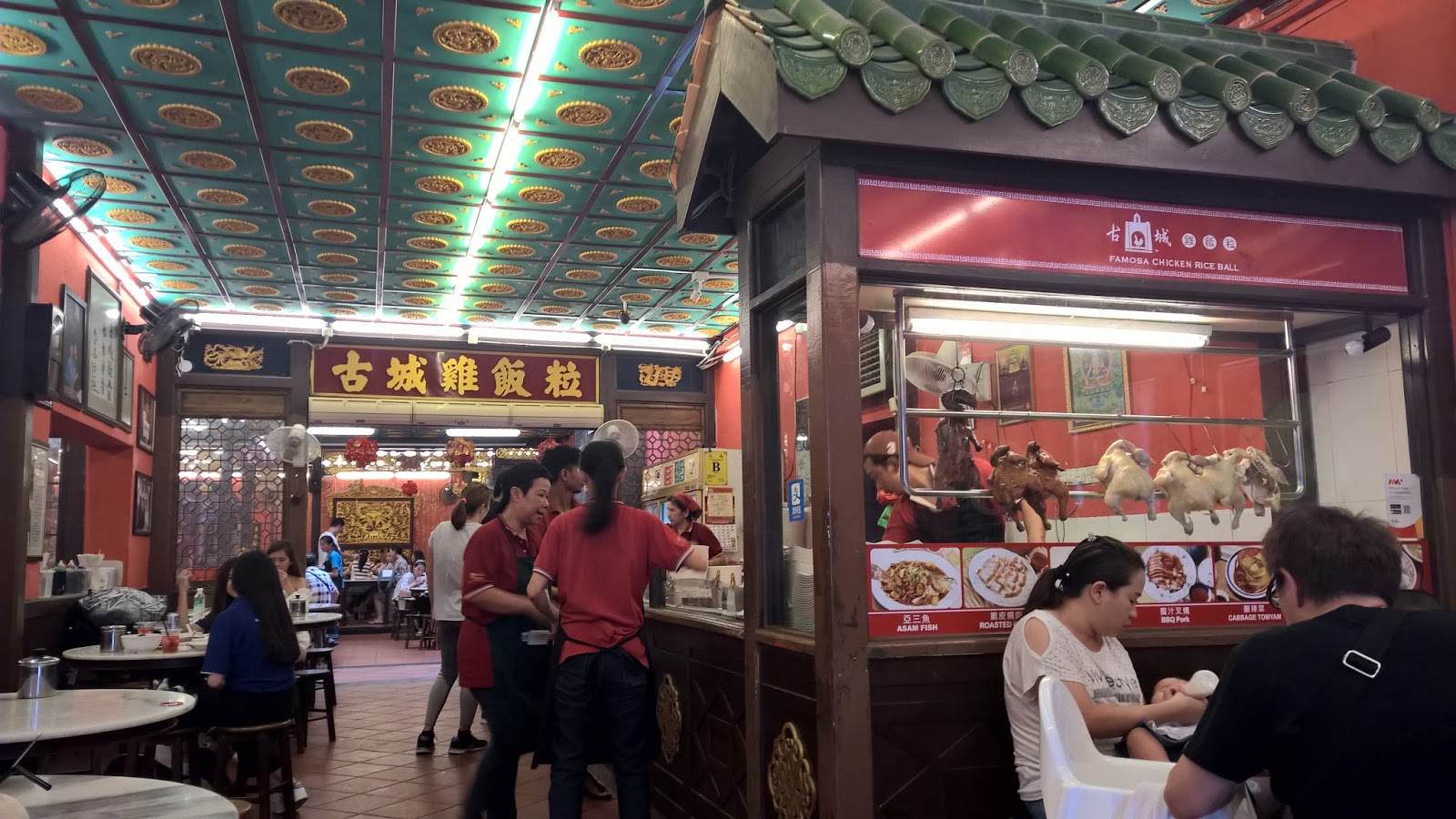
One of the famous dishes at Jonker Walk is the chicken rice ball. I'm not that much a fan, but it's a novelty thing to me.

Copyright © Favian Ee  Apr 2018
Famosa Chicken Rick Ball Restaurant

Copyright © Favian Ee  Apr 2018
Chicken rice ball, kampong chicken, coconut


Interestingly our favourite dish/drink during this trip was from a restaurant in Dataran mall, Urban Food Hall. The Thai Fried Rice and Buah Soda Gembira were awsum.

Copyright © Favian Ee  Apr 2018

Copyright © Favian Ee  Apr 2018

Copyright © Favian Ee  Apr 2018
Stirred


Our favourite breakfast place was Daily Fix along Jonker Walk as previously mentioned. The Rose Latte (latte with rose syrup) was really nice too.

Copyright © Favian Ee  Apr 2018

Copyright © Favian Ee  Apr 2018
Rose latte - with rose syrup and rose buds

Copyright © Favian Ee  Apr 2018
18 RM Eggs Benedict!!

Copyright © Favian Ee  Apr 2018

Copyright © Favian Ee  Apr 2018

Copyright © Favian Ee  Apr 2018


Sketches


I managed 2 sketches during this trip. It wasn't quite a sketching trip after all. I brought 3 sketchbooks and during the first sketch, a bird bombed one of my unused sketchbooks which was in my pouch. I threw that sketchbook away. It wasn't expensive anyway. That's the risk you take for sitting under shade. It did rain during our stay, which was the first shower in a long while, and it drizzled on the third day, which cooled things down from the roasting first 2 days. I wanted to draw my great grandmother's house but there was nowhere to sit opposite it except next to some smelly dustbins. I settled for drawing the Porta de Santiago and the Dutch Square. Each sketch probably took 2+ hours, and each sketch was marred by a leaky fountain pen.


Copyright © Favian Ee  Apr 2018

Copyright © Favian Ee  Apr 2018
Sketch completed at A&W with a cold root beer